






Padel typically requires more capital to build, but it has a larger established player base in Britain and can support strong court-booking revenues. Pickleball can offer a lower-cost route into the racket-sport market, particularly when existing courts or indoor spaces can be converted rather than built from scratch.
Neither sport is automatically the better investment. The right choice depends on site size, available capital, local competition, expected booking demand and how quickly an operator needs the venue to start generating revenue. Johnson Reed works with operators across both sports to arrange the equipment and venue finance needed to get courts open without funding the entire project upfront.
Both sports have moved well beyond novelty status in the UK. Padel infrastructure has expanded rapidly over the past few years, while pickleball continues to grow from a smaller base and has gained formal recognition as a sport across the UK. For anyone considering investing in a racket-sport venue, understanding the numbers behind each model is an important part of deciding where to put capital.
Padel vs. Pickleball: The Core Numbers for Investors
Padel currently has the larger established player base. LTA figures show that participation doubled during 2025 to around 860,000 players and has since passed one million. Britain had 1,553 padel courts across 559 venues at the end of 2025.
That expansion has significantly outpaced earlier expectations. In its 2024 padel strategy, the LTA had set a target of increasing the number of courts from 350 to 1,000 by the end of 2026. The network had already moved beyond 1,500 courts by the end of 2025.
Pickleball is smaller in absolute terms but is also growing quickly. Pickleball England estimated during 2025 that there were more than 50,000 players and over 800 places to play across the UK. The sport was formally recognised by the four Home Country Sports Councils in December 2024, with Pickleball England recognised by Sport England as the National Governing Body for the sport in England.
Build Cost:
Build costs tell a different story. A commercial padel court in the UK is commonly quoted in the region of £45,000 to £80,000 per court, depending on the specification and site. Operators should check carefully what is included, because complex groundworks, drainage, planning requirements and additional facilities can push total project costs higher.
Pickleball can be considerably cheaper when an operator is converting an existing tennis court, badminton facility or suitable hard surface. A completely new outdoor court should not automatically be treated as a sub-£30,000 project, however. One established UK court builder currently quotes around £35,000 to £40,000 plus VAT for a new hard pickleball court including groundworks and surfacing, before extras such as fencing are added.
That distinction matters for investors. Pickleball can offer a lower entry cost where existing space can be adapted, while a purpose-built venue still requires proper budgeting for surfaces, drainage, fencing, lighting and surrounding infrastructure. Rather than relying on a fixed cost ratio between padel and pickleball, operators should compare total project cost with realistic revenue and utilisation forecasts for their individual site.
Site Footprint and Court Efficiency
Space is often a deciding factor before cost even enters the conversation.
A regulation padel court has an internal playing area of 20 metres by 10 metres and is enclosed by glass and mesh walls. The complete site requirement will be larger once foundations, access routes, spacing, spectator areas and other operational requirements are considered.
The relatively compact playing area is one reason padel has proved attractive to existing tennis clubs, leisure venues and other operators looking to introduce an additional racket sport without necessarily acquiring an entirely new site.
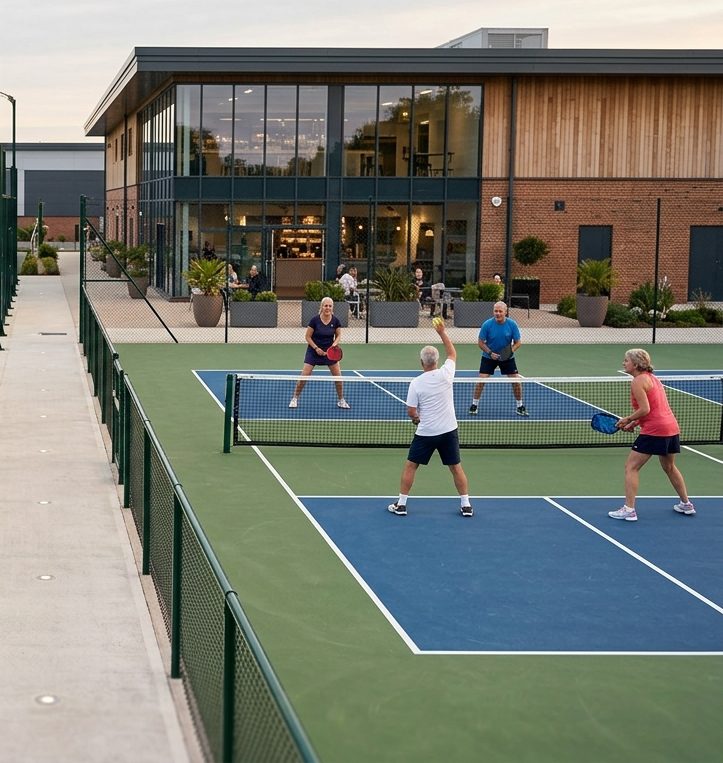
Pickleball courts are smaller still. The official playing court is approximately 13.4 metres by 6.1 metres, although commercial venues also need sufficient space around each court for safe play and circulation. Pickleball England notes that, outdoors, up to four pickleball courts can be positioned within the area used by one tennis court, depending on the layout.
This can make pickleball particularly attractive where usable space is limited or an operator is looking to convert an existing tennis court, sports hall or multi-use facility. For investors, however, court density should always be considered alongside access, run-off areas, changing facilities, reception space and the overall customer experience.
How the LTA and Pickleball England Are Shaping Court Demand
Padel has benefited from significant governing-body support. When the LTA published its latest padel strategy in 2024, it said the LTA and LTA Tennis Foundation had invested £6 million into 40 padel facility projects, helping to fund 75 new courts alongside investment in coaching, competition and player development.
The subsequent growth of the sport has been considerably faster than the targets set at the time. The LTA aimed for 1,000 courts by the end of 2026, but Britain had already exceeded 1,500 by the end of 2025.
Pickleball’s governing structure is at an earlier stage, but recognition has also progressed. In December 2024, pickleball was formally recognised by Sport England, sportscotland, Sport Wales and Sport Northern Ireland, while Pickleball England was recognised as the National Governing Body for the sport in England.
Participation indicators also continue to move upwards. Pickleball England’s English Open grew from 1,059 players in 2023 to 2,350 in 2025, illustrating the expansion of the competitive side of the sport alongside recreational play.
For prospective operators, national growth figures are useful context, but they should not replace local research. Existing court supply, population, competing venues, local racket-sport participation and achievable booking prices are more useful when deciding whether a specific site has enough demand.
Revenue Potential and Speed to Break Even
Padel courts can command relatively strong hourly booking rates. Johnson Reed’s existing padel investment guide notes that many operators charge in the region of £20 to £40 per court per hour, although actual pricing varies considerably by location, venue quality, peak times and local competition.
Revenue can also extend beyond standard court hire. Coaching programmes, memberships, leagues, tournaments, equipment sales and food and drink can all contribute to the overall venue model. For larger padel facilities in particular, these additional revenue streams can be important when assessing whether the investment works financially.
Pickleball can have a different cost profile. Converting an existing suitable surface may significantly reduce the initial capital requirement, while the smaller court dimensions can allow operators to create several bookable courts within a relatively compact area.
That does not automatically mean pickleball will reach breakeven faster. A lower construction cost is only one part of the calculation. Booking prices, utilisation, rent, staffing, utilities, marketing, maintenance and any debt repayments all affect the point at which a venue becomes profitable.
The same applies to padel. A well-located padel venue with strong demand may justify a higher initial investment, while a lower-cost pickleball development can struggle if the local player base or achievable booking price is too small.
For either sport, site selection and realistic occupancy forecasts are usually more useful than broad national assumptions about which type of venue provides the fastest return.
Choosing Between Padel and Pickleball for Your Site
Operators converting or expanding an existing tennis, leisure or racket-sport facility may find padel a natural addition, particularly where there is enough external or indoor space for enclosed courts and an existing customer base interested in racket sports.
A fitness or leisure finance package can help spread eligible equipment and fit-out costs rather than requiring the entire investment upfront.
Operators working with a smaller footprint or looking to convert an existing sports surface may find pickleball offers a lower-cost way to add bookable court capacity. It can also make sense in locations where local padel competition is already strong or where the available space does not suit a padel development.
The two sports do not have to be mutually exclusive. Depending on the size and layout of the facility, a mixed racket-sport venue can diversify revenue and allow operators to serve different groups of players.
Before choosing either route, operators should model the complete project rather than focusing only on the headline cost of the courts. Groundworks, planning, lighting, changing facilities, booking systems, staffing, launch marketing and working capital can all materially affect the final investment.
Using a finance calculator can provide an initial indication of potential monthly repayments to compare against forecast venue revenue.
Funding a Padel or Pickleball Venue
The cost of opening a racket-sport venue rarely stops at the court itself. Depending on the project and lender, funding may be available for court installation, playing surfaces, lighting, fencing, flooring, access systems, changing facilities and other equipment.
Johnson Reed offers business equipment finance that can help businesses spread eligible capital expenditure over an agreed term, helping to preserve working capital for costs such as staffing, marketing and day-to-day operations.
For operators building new padel courts or expanding an existing venue, Johnson Reed provides dedicated padel finance for projects including courts, flooring, lighting and multi-court developments.
A separate pickleball finance service is available for projects including indoor and outdoor court installations, court conversions, lighting, flooring, nets, fencing and larger multi-court developments.
Depending on eligibility and lender appetite, larger projects may also be able to use finance supported by the government’s Growth Guarantee Scheme. The scheme remains open for applications and supports products including term loans and asset finance, with the government providing participating lenders with a 70% guarantee on eligible facilities. The borrower remains responsible for repaying the full amount.
Operators should also consider wider business loan options where a project includes costs that may sit outside conventional equipment or asset finance. Depending on the lender and application, this could provide additional flexibility for the wider costs involved in getting a new venue trading.
All finance remains subject to status, lender criteria and affordability.
Summary and Next Steps
Padel has the larger established player base in Britain, with participation now exceeding one million and more than 1,500 courts already in operation. It can support attractive booking revenues, but building a padel facility typically requires a significant initial investment.
Pickleball is developing from a smaller base and can offer a lower-cost route into racket-sport venues, particularly where existing tennis courts, sports halls or other suitable surfaces can be converted. A completely new pickleball court, however, can still represent a substantial investment once groundworks, surfacing, fencing and other infrastructure are taken into account.
The better investment therefore depends on the site, local demand, available budget, competition and the revenue an operator can realistically generate from each court.
If you are weighing up a padel or pickleball venue and want to understand the financing options before committing capital, get in touch with the Johnson Reed team to discuss court finance, equipment funding and repayment structures for your project.
Frequently Asked Questions
Is padel or pickleball a better investment in the UK?
Neither sport is automatically a better investment. Padel has a larger established player base in Britain and can support strong booking revenues, but court construction generally requires more capital. Pickleball can cost less to introduce, particularly when existing courts or indoor facilities are converted. The right option depends on available space, project cost, local competition and expected demand.
How much does it cost to build a padel court in the UK?
A commercial padel court in the UK is commonly quoted at around £45,000 to £80,000, depending on specification and site conditions. Operators should check whether groundworks, drainage, planning, lighting and other infrastructure are included, as these can increase the overall project cost.
How much does it cost to build a pickleball court in the UK?
The cost depends heavily on whether an existing surface is being converted or a completely new court is being constructed. Conversions can be considerably cheaper. For a new hard court, one established UK builder quotes approximately £35,000 to £40,000 plus VAT including groundworks and surfacing, with items such as fencing potentially adding to the cost.
How many padel or pickleball courts fit on a tennis-court-sized site?
The playing area of a padel court is 20 metres by 10 metres, while a pickleball court is approximately 13.4 metres by 6.1 metres. The number that can be fitted onto a site depends on the full available footprint, access and safety requirements. Pickleball England states that up to four outdoor pickleball courts can be accommodated within one tennis court area.
Which sport is growing faster in the UK?
Both padel and pickleball are growing quickly, but available statistics do not provide a reliable like-for-like percentage comparison. LTA figures show padel participation doubled during 2025 and has since exceeded one million players. Pickleball England has also reported strong growth in participation, membership and tournament entries from a much smaller starting point.
How many padel courts are there in the UK?
The LTA reported 1,553 padel courts across 559 venues in Britain at the end of 2025.
Can I finance the construction of a padel or pickleball venue?
Yes, depending on the project and lender. Finance can potentially be used for costs including court installations, flooring, lighting, fencing and associated equipment, while business loans may be considered for some wider project costs. All finance is subject to lender criteria, status and affordability.